














About Us

Let’s get to know
each other

About Us Illustration
Our Values and Objectives

OUR
VALUES
AND
OBJECTIVES

Promoting volunteering in sailing

We encourage and support volunteering as an essential part of sailing culture and community development.

Supporting clubs and federations

We help sailing organisations create effective volunteer programmes and share best practices across Europe.

Creating a digital platform

We develop an online platform that connects volunteers with sailing clubs and event organisers.

Building international experience

We promote cooperation and knowledge exchange between young volunteers through meetings and workshops.

CO-FUNDING

All Hands on Deck is co-funded by the European Union under the Erasmus+ Programme.

The project “All Hands on Deck” is co-funded by the European Union under the Erasmus+ Programme. The views and opinions expressed are those of the authors only and do not necessarily reflect those of the European Union or the European Education and Culture Executive Agency (EACEA). Neither the European Union nor EACEA can be held responsible for them.

DELIVERABLES

Volunteering manual

Workshops for volunteers

Digital platform for volunteers and organizers

OUR PARTNERS

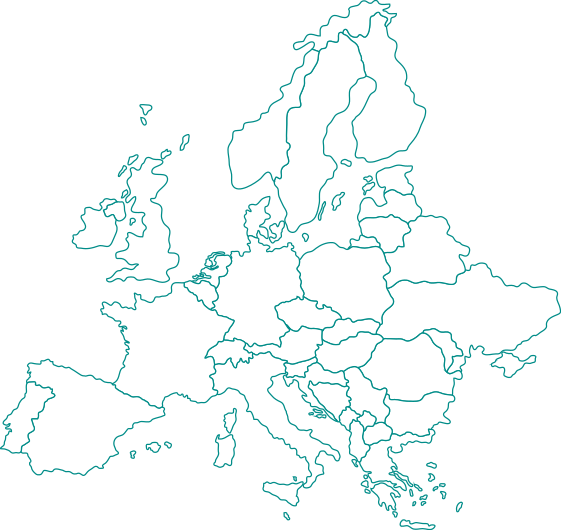
Map

The project “All Hands on Deck” brings together seven organisations from across Eastern Europe – sailing federations, clubs and a maritime university.

Together, they work to promote volunteering in sailing, support young people in gaining international experience and create tools that help organisations engage volunteers more effectively.

The partnership combines practical expertise in sailing, youth work and maritime education, ensuring a strong foundation for developing sustainable volunteering practices in the region.

Slovak Sailing Federation

The Slovak Sailing Federation connects athletes, fans and experts in sailing throughout Slovakia. As the national authority, it represents Slovakia internationally and works to grow participation, especially in youth competitions and also high performance sailing, e.g. Olympics. It creates a platform for sailing clubs, class associations and sailing experts such as coaches, race officials and organizers to develop and promote the sport to the public. Federation and its committees support top athletes in dinghy and windsurfing classes and also invite keelboat crews as well as radio-controlled sailing enthusiasts to participate in local and international sailing events. The Federation also supports its clubs with event organization, education, and access to international networks, while relying mainly on engagement of volunteers to drive long-term development of Slovak sailing.

Read more

Polish Yachting Association

The Polish Yachting Association is an organisation that brings together a wide range of sailing enthusiasts and supporters. The aim of the Association is to support the development of sailing in all its forms, in particular Olympic and youth sailing, among other things by creating new sailing infrastructure and maintaining existing infrastructure, supporting activities for the safety of yachting and all forms of cultural activities related to sailing, and supporting activities for the protection of the natural environment related to sailing. The Association is a leader in the field of sailing education, implementing leading training programmes, including the PolSailing National Sailing Education Programme, and in the field of acquiring and organising the largest sailing, maritime and inland waterway sporting events.

Read more

Turkish Sailing Federation

The Turkish Sailing Federation is a national youth and sports organization committed to nurturing well-rounded, healthy, and resilient young individuals through the sport of sailing. With a vision to foster a new generation that is active, disciplined, the Federation promotes access to sailing across all coastal regions of Türkiye. Operating under the leadership of its President and with the strategic input of its committees and advisory boards, the Federation carries out a wide range of programs—local, national, and international—that aim to expand the reach of sailing and elevate Türkiye’s position in global maritime sports. Beyond preparing athletes for national competitions, the Federation actively supports participation in European and World Championships, as well as Olympic events. It is committed to helping Türkiye become a key player on the international sailing stage. To ensure sustainability and growth, the Federation actively engages in international partnerships—most notably within the Erasmus+ framework—giving young people opportunities to connect with peers from other cultures and explore shared values through the unifying power of sport. In addition, the Federation offers certified training programs in Sailing Instruction recognized by the Ministry of National Education, Coaching, Officiating, and Amateur Seamanship—. These programs not only develop successful athletes but also equip coaches, referees, and future sailors with the skills, knowledge, and mindset needed to thrive in the maritime world

Read more

Hungarian Sailing Federation

The Hungarian Sailing Federation (HSF), established in 1929, is the umbrella organization for member associations. Individual sailors participate in the system through their membership in these associations. Since its foundation, the federation has been led by 20 presidents. Today, HSF comprises 155 clubs with more than four thousand members. Across Hungary’s lakes, member associations organize over two hundred sailing competitions each year. Competitors can contest national championship titles in 50–55 different categories and boat classes. Hungarian sailing is strongly integrated into the international competitive scene. World and European Championships, as well as European Cup races, are held on Lake Balaton four to six times a year across various boat classes. Numerous volunteers are involved in organizing competitions within the clubs, which is why HSF can serve as a valuable partner in this collaboration, bringing extensive experience in volunteer engagement.

Read more

Yacht Club "Port Bourgas" (Bulgaria)

Yacht Club “Port Bourgas” is a non-government organisation in public benefit, organised and registered under the laws of the Republic of Bulgaria. The club has 50 years of history. Yacht Club “Port Bourgas” was established in 1976 as a department within the Port of Bourgas. Yacht Club “Port Bourgas” is focusing on educating and developing youth sailing, training young people to spend more time among nature. The main goals of the club are: development of sea sports and tourism with sailing yachts and other boats; organizing sea adventures of its members and supporting them to handle their proper marine education; protecting the environment; organizing and taking part in regattas and other sea events; education and training of children and youths; establishment of partnership with similar organizations worldwide; working for social integration and personal improvement.

Read more

Tallinn Yacht Club (Estonia)

Tallinn Yacht Club was founded in 1910. Our club is a member of the Estonian Sailing Federation. Today Tallinn Yacht Club is located in the newest and most modern marina in Estonia - Haven Kakumae. Tallinn Yacht Club runs a sailing school that has 150 sailors in 3 different locations: Pirita Harbour, Haven Kakumae and Lohusalu Harbour. The club annually organizes three large Estonian dinghy regattas - Tallinn Yacht Club Cup in Lohusalu, Tallinn Race in Seaplane Harbour as part of the Tallinn Maritime Days, Tallinn Week in Haven Kakumäe. Since 2022 the club organises dinghy regatta series Kakumäe GP and keelboat regatta series Thursday Sail that covers the whole season. One of the yearly highlights for club members is Squadron Sail that takes our big boats along the Estonian or Finnish coast in the third week of July. Our club organises Pleasure Craft Operator and SRC Radio courses twice a year in Haven Kakumäe.

Read more

Constanta Maritime University (Romania)

Constanta Maritime University is a leading higher education institution in the maritime field. Established in 1990, the university is accredited by the Ministry of Education (ME), the Romanian Agency for Quality Assurance in Higher Education (ARACIS), and the Romanian Naval Authority (ANR). Since its foundation, CMU has been committed to continuously updating its educational offer to meet the evolving needs of the global industry. Today, the university stands out as one of the Romanian higher education institutions most closely connected to real economic conditions. CMU’s study programs are designed for the international maritime sector, training highly skilled professionals capable of facing global competition and working in multicultural environments. CMU has established over 30 partnerships with maritime institutions worldwide, aimed at fostering cooperation in teaching and research, supporting staff exchanges and continuous education in areas of mutual interest, and expanding cultural and academic experiences for faculty and students. The university’s membership in renowned international organizations reflects its dedication to strengthening the theoretical and practical training of future seafarers, based on the belief that effective maritime education relies on scientific and academic rigor, practical skills, management competence, and a strong focus on quality. CMU is affiliated with the following international organizations: the International Association of Maritime Universities (IAMU), the Black Sea Association of Maritime Institutions (BSAMI), the International Maritime Lecturers Association (IMLA), the International Association of Universities (IAU), and the Black Sea University Network (BSUN). Constanta Maritime University has an extensive track record of participation in EU-funded projects, both as a beneficiary and as a partner. Engagement in such projects aligns fully with CMU’s mission to promote academic and human excellence in generating knowledge and applying it to address major contemporary challenges—including digitalization, climate change and environmental protection, cyber security, and gender equality—as well as to advance innovation and quality in research, teaching, and learning.

Read more